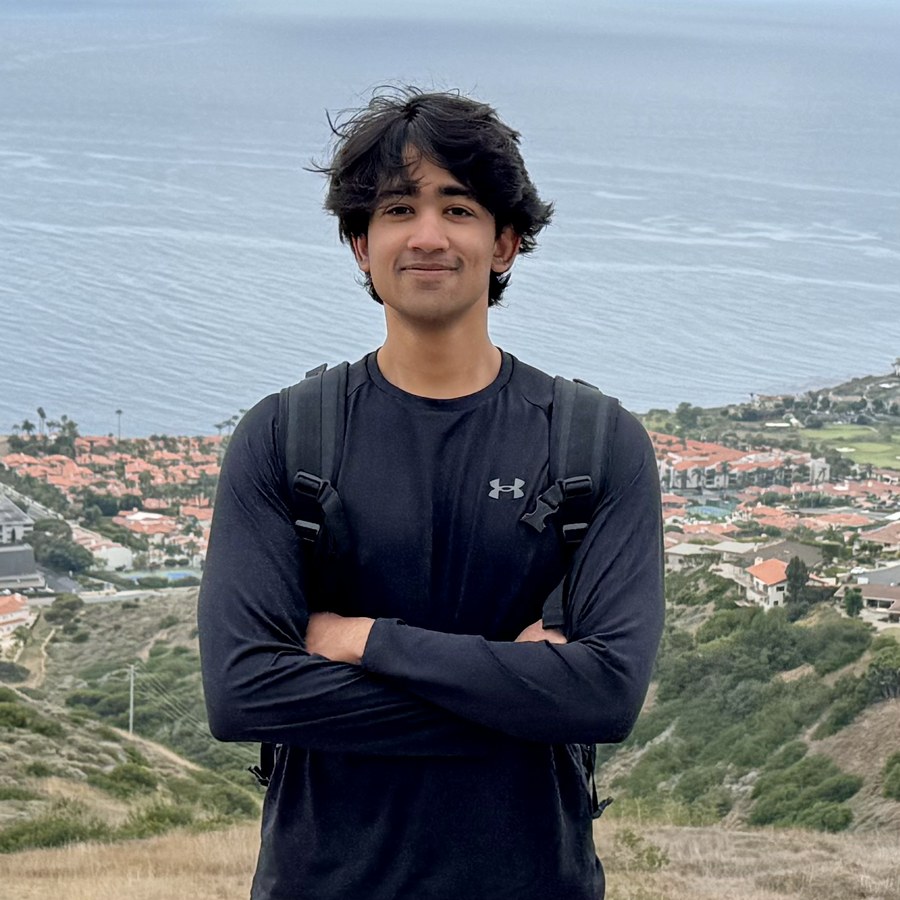
I am a master's student in Computer Science at the University of Southern
California, on the Artificial Intelligence track, advised through coursework and
project work in machine learning and applied AI. Before USC I completed a bachelor's degree
in Artificial Intelligence and Machine Learning at Guru Gobind Singh Indraprastha
University in Delhi, graduating as a Bronze Medalist from the 2025 batch.
My research concerns how meaning is distributed across modalities. In
natural conversation, the signal that matters is rarely confined to the words: it is
carried by prosody, by facial affect, and by timing relative to the other speaker. My
current project treats this directly. Given a recorded dyadic exchange, the task is to
localize the specific utterance at which the interaction shifts from cooperative to
adversarial, which means aligning three asynchronous streams at utterance granularity
rather than pooling them into a single clip-level embedding. A transformer architecture I
designed and trained from scratch reaches 86.7% accuracy on this task
over twenty hours of annotated dialogue, exceeding a strong Gemini API baseline by
7.2 percentage points.
Working on that problem left me with a broader unease, and it is the thing I have spent
this year following. A model can look competent on the evaluation you happen to run and
still be holding its answer together loosely. Two projects this fall put that suspicion
under a controlled test. The first asks what a language model should rehearse.
An assistant is rarely tuned once: it is tuned for helpfulness, then for safety, then for
instruction following, and every stage quietly erodes what the one before it taught. Given
a replay budget of ten percent, we record how far each stored preference pair's DPO margin
has fallen from its peak, replay the pairs that lost the most, and check that rule against
random and difficulty-based selection under an identical update budget.
The second project asks what a vision-language model is really reading. Expense and hiring
pipelines now hand receipts and résumés straight to a VLM, and the person uploading the
file is not always a neutral party. We optimize bounded pixel perturbations that leave the
page visibly unchanged, measure whether they can force a chosen false total or a
credential the document never states, and then test which lightweight defenses still hold
once the attacker knows they are in place. Both projects interest me for the same reason
the conflict work does: they ask what a model has actually learned, rather than what it
manages to output on a good day.
Running alongside the research is a second interest in whether these methods survive
contact with practice. Over two summers at Novartis and
ZS Associates I built gradient-boosted models for identifying early
adopters of therapies in markets that did not yet exist, and retrieval-augmented systems
that pair a language model with a deterministic calculation layer so that generated
figures remain auditable. The constraints in that setting, interpretability, calibration,
and the cost of a false positive to a real clinician, shaped how I evaluate models
generally.
I am currently looking for full-time machine learning engineer roles and,
in parallel, doctoral programs in multimodal learning and the reliability
of post-trained models. If you work on problems where the interesting structure lies
between modalities, or on what survives the next round of training, I would be glad to
hear from you.